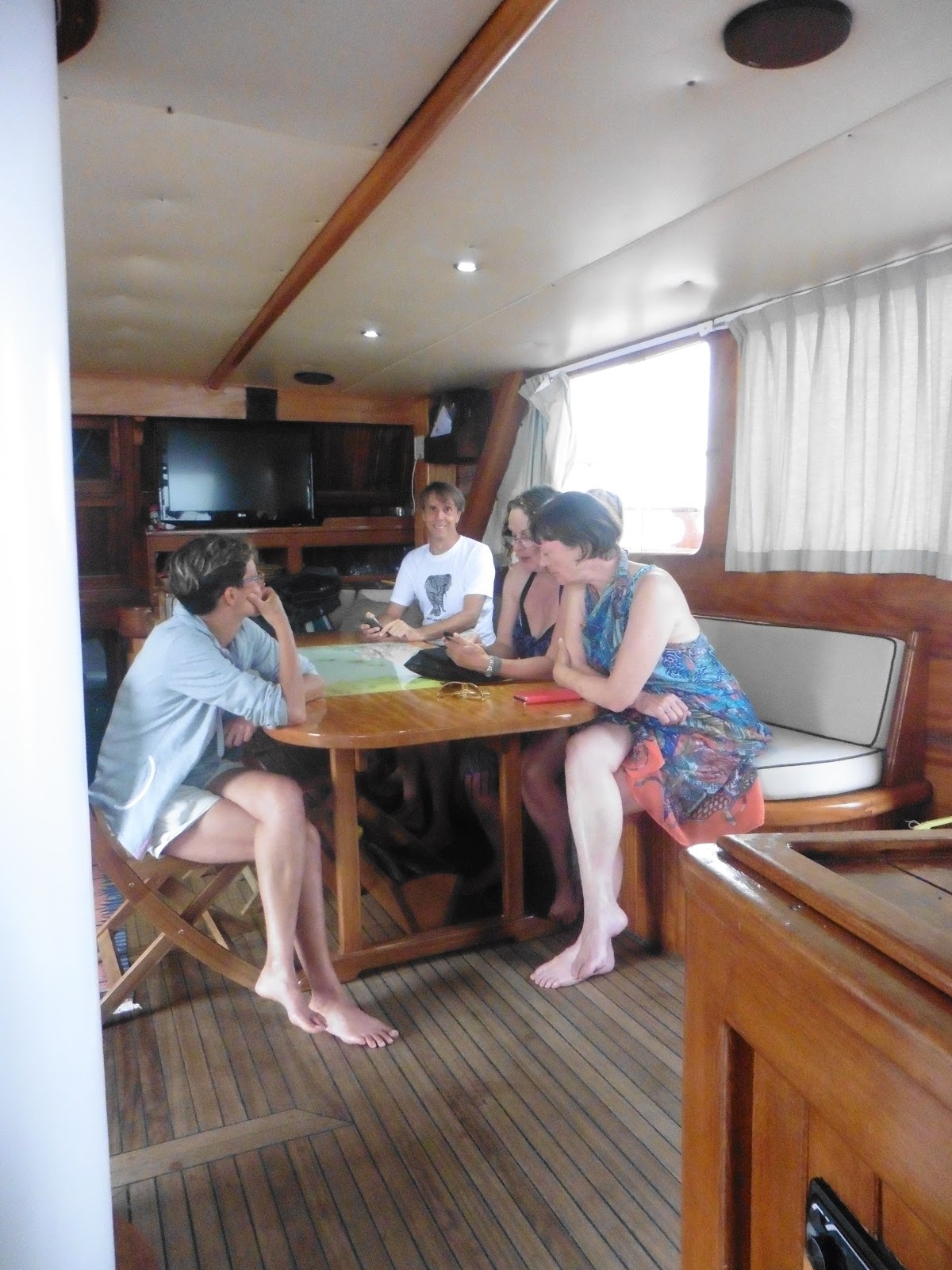
I woke at 0715 & considered turning over & going back to sleep, but in the end I got up in case this morning's brekkers was earlier than the usual 0830.
It was, & Elizabeth actually left for her flight before 8, so the goodbyes began.
I E'd Armando 1st so he'd be forewarned of my arrival in Giarre, ate, & then got my bags up from the cabin where Lorella was just packing.
I said my own goodbyes & was ashore by 0845, ready to walk the K & a half to the bus stop, getting there by 5 past 9.
 |
| The view of the one of the tunnels from the bus |
Um?
My notes don't say, & 20 months after the event, I haven't got a clue!
I got a front seat for the views.
There were quite a lot of tunnels on the way to Messina, but I only took a pic of one: seen one, seen 'em all, eh? ;-)
 |
| Mainland Italy across the Strait of Messina with wonderful Roman nose for perspective ;-) |
The guy on the other front seat was coughing a lot, & when I noticed his Roman nose I decided to get a photo: when in Rome & all that ;-p
 |
| A pic of the bus stop where I'd waited on the way out |
I combined the Roman nose with a view of the Italian mainland in Calabria.
The journey wasn't long, & I grabbed a few pics of this & that in Messina as we drove by.
 |
| Another view of Messina from the bus |
Once off the bus at 1010, I had a bit of a rush to find out about tickets to Giarre, buy one, & find which platform I needed for the 1025.
 |
| Pointy bit of mainland in distance & a fishing boat south of Messina |
Safely aboard, I texted Armando so he'd know what time I was due to arrive in Giarre.
He had very kindly offered to pick me up from Giarre-Riposto station ~ about 13K from Zafferana Etnea where he lived.
Then I sat back to enjoy the ride south.
 |
| No idea, but it was before the train got to Taormina |
 |
| Taormina's Giardini Naxos bech to the south of the town |
 |
| Cute station lights somewhere south of Taormina |
It would be good to do a full ride along the coast.
Maybe another time??
 |
| My bedroom at Armando's |
The train was a bit late into Giarre-Riposto, & Armando was on the platform to greet me.
He chivalrously carried my little ruckie to the car, & commented on how small it was & did I not have a suitcase? ;-)
Happily, his English was much better than my Italian :-))
 |
| Armando's house. Via Ginestre is behind the palm |
His car was a bit battered, but we sped up into the hills of Etna's slopes to Zafferana Etnea.
My notes say the drive was "slightly hairy" hehehe
Armando's house was on the hillside above the village, & had wonderful views in all directions.
 |
| Lush Sicilian hills from the balcony ~ & a lava field! |
 |
| The view north east from the balcony |
So, once I had put my minimal luggage into the lovely bedroom, I changed into shorts (I had worn trousers to save carrying them, & it was well hot by this time), grabbed the Lumix, & went exploring to get some pics of the outside bits.
While I was wandering around, soaking up the sun & getting acquainted with the local cats, Armando was preparing lunch.
Awesome!
Home-made Sicilian cooking :-q
By the time I got back indoors for the 'indoors pics' the smells coming from the kitchen were marvellous.
I couldn't wait!
As is completely normal, my notes (written round the edge of my Print My Sudoku pages) are rather like the hieroglyphics written by folks chipping rocks with stone tools which can only be read by well studied peeps from a university.
That is, pretty hard to read!
As is completely normal, my notes (written round the edge of my Print My Sudoku pages) are rather like the hieroglyphics written by folks chipping rocks with stone tools which can only be read by well studied peeps from a university.
 |
| Lava flow to WNW of Armando's ~ very zoomed |
 |
| Zafferana Etnea rooftops |
 |
| Armando's bathroom |
I have googled lazolia in various spellings, but found nothing to suggest that it was a Sicilan fruit or anything which could be put in a bottle to create an alcoholic drink.
So, although I have a pic showing it was Crema di Mandarino made in 2017, I have no idea why I
 |
| The lounge |
wrote lazolia.
Um?
The hieroglyph hex strikes again.
Bum.
 |
| The balcony looking south |
Lunch also included a glass of Sicilian red & some very strong coffee, but the latter did not stop Armando from getting out a sun-lounger on the balcony after we had washed-up, & putting his feet up for a post-luncheon forty winks*
 |
| Armando dishes up lunch, Sicilian style, naturally :-q |
My notes say he went to sleep at 1410 - see below for how long!
 |
| My awesome lunch |
 |
| Una goccia di alcol to finish |
Before he had his siesta,
Armando laid a lounger out for me to use, but put it in the shade.
So, being the cat that I am, I quietly put it into the sun ;-)
Then I got out my sudoku pages (ie - the ones with the notes around the edge! ;-p ) & wrote about the day so far before starting another 'diabolic' puzzle.
Print My Sudoku lets you choose between Easy, Medium, Hard & Diabolic, & I had been taking several pages worth of Hard & Diabolic ones on
 |
| Armando's home brew. It was yummy |
I recall taking 6 books with me to Sienna in 2004 & running out 1/2 way through the 2 weeks.
The spines also melted in the heat of the August sun, so most were in a mess by the time I'd read them :-/
So, at some point in 2016, I decided to take sudoku to do on journeys or in bed etc, instead of books.
Plus, the pages had the added benefit of being a repository for my thoughts & recollections of each day, & meaning I didn't have to save extra notepaper: save the planet & all that :-)
Anyway . . .
By 2:25 the sun was getting the better of me & I fell asleep till just before 3.
Armando was still asleep when I woke & moved my bed back into to sun, but he woke at about 1530 & proposed we drove up to the lava field created by the 1995 eruption.
Anyway . . .
By 2:25 the sun was getting the better of me & I fell asleep till just before 3.
Armando was still asleep when I woke & moved my bed back into to sun, but he woke at about 1530 & proposed we drove up to the lava field created by the 1995 eruption.
 |
| Armando on the lava field near a (now deserted) farmhouse |
He made a pot of espresso to wake us up from our cat-nap, & we left for the lava field, arriving in the car park by the deserted farmhouse just after 4.
It was still lovely & warm :-))
As I'll be riding around it for 3 days, here is a bit about it from Wiki:
Mount Etna, or Etna is an active stratovolcano on the east coast of Sicily, between the cities of Messina & Catania. It lies above the convergent plate margin between the African Plate and the Eurasian Plate. It is the highest active volcano in Europe outside the Caucasus and the highest peak in Italy south of the Alps with a current height of 3,326 m (10,912 ft), though this varies with summit eruptions. Etna covers an area of 1,190 sq km (459 sq mi) with a basal circumference of 140 km (87 miles). This makes it by far the largest of the three active volcanoes in Italy, being about two and a half times the height of the next largest, Mount Vesuvius. Only Mount Teide on Tenerife in the Canary Islands surpasses it in the whole of the European–North-African region west of the Black Sea. The 1991–1993 eruption saw the town of Zafferana threatened by a lava flow, but successful diversion efforts saved the town with the loss of only one building a few hundred metres from the town's margin. The town spread around the Priory of San Giacomo, founded in 1387 in the upper part of the Valle del Bove, the point of confluence of the lava streams from Etna's Eastern craters which frequently have destroyed the town, which has always been rebuilt. Zafferana Etnea was threatened by the 1992 volcanic eruption of Mt. Etna. It is now a summer resort with views of landscapes toward both the mountain and the sea.
I also got this from the New York Times website. It's an April 25th 1992 article by Alan Cowell (I edited it a bit)
It was still lovely & warm :-))
As I'll be riding around it for 3 days, here is a bit about it from Wiki:
Mount Etna, or Etna is an active stratovolcano on the east coast of Sicily, between the cities of Messina & Catania. It lies above the convergent plate margin between the African Plate and the Eurasian Plate. It is the highest active volcano in Europe outside the Caucasus and the highest peak in Italy south of the Alps with a current height of 3,326 m (10,912 ft), though this varies with summit eruptions. Etna covers an area of 1,190 sq km (459 sq mi) with a basal circumference of 140 km (87 miles). This makes it by far the largest of the three active volcanoes in Italy, being about two and a half times the height of the next largest, Mount Vesuvius. Only Mount Teide on Tenerife in the Canary Islands surpasses it in the whole of the European–North-African region west of the Black Sea. The 1991–1993 eruption saw the town of Zafferana threatened by a lava flow, but successful diversion efforts saved the town with the loss of only one building a few hundred metres from the town's margin. The town spread around the Priory of San Giacomo, founded in 1387 in the upper part of the Valle del Bove, the point of confluence of the lava streams from Etna's Eastern craters which frequently have destroyed the town, which has always been rebuilt. Zafferana Etnea was threatened by the 1992 volcanic eruption of Mt. Etna. It is now a summer resort with views of landscapes toward both the mountain and the sea.
I also got this from the New York Times website. It's an April 25th 1992 article by Alan Cowell (I edited it a bit)
Zafferana Etnea Journal; It's Plug Up Mt. Etna or Go the Way of Pompeii
What do American marines aboard an aircraft carrier in the Mediterranean do as an encore to the Persian Gulf war and its aftermath? For some, at least, they drop seven-ton concrete blocks from America's biggest military helicopters hovering 15 feet over molten lava on Mount Etna to save an Italian village from the volcano's wrath.
"Everything is easier when no one is shooting at you," said Comdr. John Carpenter of the Navy, the air operations officer at the United States Sigonella naval base at Catania near this Sicilian mountain village of 7,000 people threatened by the lava flow.
 |
| The lava came Very close, despite being bombed! |
"It's still a very challenging operation," said Maj. Jim Ross of the Marines, a 36-year-old gulf war veteran pilot who helped plug a hole in the lava flow the other day by swinging a concrete block back and forth below his C-53 helicopter to push other concrete blocks into the hole. "It was like croquet," the Commander said. Still, in this battle between human ingenuity and military high-tech on one side and nature's caprice and the slow, brute flow of the lava on the other, there are no clear winners. Indeed, this afternoon, in a vineyard and orchard on the outskirts of Zafferana Etnea, the lava flow was moving again, a malignant monster on a 100-yard front, 15-feet high, gray-black and inexorable. For moments it would seem to pause as its outer crust solidified. Then, with a clink and hiss and clattering, the hot lava within inched forward, shedding the crust before it, showing itself in places in molten-red seams that set trees alight.
The snow-capped Mount Etna, at 10,900 feet, is Europe's tallest and most active volcano, and it began to erupt in December. Dams were built to contain its lava where it usually settles in a high bowl near the snow-capped peak. But the dams broke and the lava began to flow. As its crust cooled and hardened, it created an insulated tunnel for the molten lava to flow through, curling down the valley that leads right through the middle of the village. As it moved thus, the tunnel was extended and the lava flowed farther down.
At present, it stands at the village's edge, and is still moving. It has so far destroyed one house, whose owner had set a table with wine and bread to appease it. This afternoon, in half an hour, it burned a fruit tree in its last bloom, and moved on.
Almost two weeks ago, Italian volcanologists, who had used explosives to try to divert the flow, asked the United States to help. So, apart from the C-53 helicopters at Sigonella base, a helicopter squadron from the 24th Marine Expeditionary Unit also arrived. Just about every pilot in the unit, Major Ross said, had flown either in the war to evict Iraq from Kuwait or the subsequent operation to protect Iraq's Kurds. Some Marine and Navy pilots had flown in other operations to take American diplomats to safety from civil conflicts in Somalia and Liberia.
By comparison, said Major Ross, Operation Volcano Buster, as the Marines called this deployment -- a logo they painted on the sides of their helicopters -- was "not life or death." But it was nonetheless precarious.
The tactic to halt the flow in the joint Italian-American operation this week was for Italian units to use explosives to blow a hole in the lava tunnel 6,000 feet up Mount Etna, high above this village. Then, the American helicopter carried the huge concrete blocks into position around the hole and knocked them in. On Tuesday evening, the maneuver filled the hole with 92 tons of concrete and rubble that seemed to block the flow.
The main problem was the size of the eruption. Since Dec. 15, Mount Etna has disgorged 120 million cubic yards of lava, and it is still spitting out the stuff high on its flanks. So, after a brief pause, the lava started to move again, and the Italian Air Force is now planning to deploy its own Chinook heavy transport helicopters to repeat the American maneuver. It is not clear, thus, whether the American helicopters will fly again.
 |
| New growth of vegetation since 1992 |
That was not much consolation for Rosaria Russo, 54, whose vineyard and fruit trees lie in the lava's path in the steeped, wooded valley that leads down Mount Etna and on through Zafferana Etnea. "The Americans did something," she said, "but it was too late."
"They’re our fields” said a man in a faded khaki hat, his skin bronze beneath silver stubble, as the lava tramped over vines not yet in leaf. Someone jabbed a stick into the ground, a few feet before the face of the lava, & on the stick they pinned a picture of the 3 saints revered in these parts: St Philadelphia, St Alfio & St Cirino. The lava, though, didn't seem to notice.
 |
| A shot of the field of flow |
Having seen how close to the farmhouse the lava reached, we walked up the hill along a track created since 1992 from blocks of lava.
Traffic & foot fall have smoothed it out significantly since.
Lava is sharp, as my feet, shins & knees had discovered during the Pallas cruise, & I was to discover even more on Day 2 of the ride round Etna!
 |
| The road was made from lava |
Ouch :-(
But that tale's for another blog ;-p
 |
| The lava road crossed the field |
 |
Stunt bum-bag (bottom R) & the field downhill.
ZE is down on the left
|
 |
Stunt bum-bag gives persepective to the desolation of the lava field
|
During our walk by the side of the wood, Armando explained that, as well as chestnuts, its trees included
 |
| Armando looks for truffles in the chestnut wood |
birch (betula), oak (querca), & ginestre or broom.
As ginestre sounded a bit like 'gin', I thought my notes were wrong & that it
 |
| The chestnut branches will have grown back since 1992 |
may have been juniper so I googled it while writing this blog.
I found this on Wiki:
Genista aetnensis
(Mount Etna broom) is a species of
I found this on Wiki:
Genista aetnensis
(Mount Etna broom) is a species of
 |
| Incinerated tree |
flowering plant in the legume family Fabaceae. It is a small tree or large shrub endemic to Sicily & Sardinia & associated with sunny, open landscapes & poor, stony soil. It is a very common constituent of the garigue plant communities ~ Mediterranean shrubby vegetation, around the lower slopes of Mount Etna, hence its Latin specific epithet
aetnensis.
 |
| Armando leads up the smoothed path . . . |
There were also lots of chestnuts & here's interesting info from Wiki about a very special Sicilian horse chestnut:
The Hundred-Horse Chestnut or Castagno dei Cento Cavalli is the largest and oldest known chestnut tree in the world. Located on Linguaglossa road in Sant'Alfio, on the eastern slope of Mount Etna — only 8 km (5.0 mi) from the volcano's crater — it is generally believed to be 2,000 to 4,000 years old (4,000 according to the botanist Bruno Peyronel from Turin).
It is a Sweet Chestnut (Castanea sativa, family Fagaceae). Guinness World Records has listed it for the
 |
| which was still rough & rubbly in parts |
 |
| New growth finds a way |
record of "Greatest Tree Girth Ever", noting that it had a circumference of 57.9 m (190 ft) when it was measured in 1780. Above-ground the tree has since split into multiple large trunks, but below-ground these trunks still share the same roots.
The tree's name originated from a legend in which a queen of Aragon & her company of one hundred knights, during a trip to Mount Etna, were caught in a severe thunderstorm. The entire company is said to have taken shelter under the tree.
Sant'Alfio is 24K by road from ZE, as both are quite high up the mountain, but they are less than 10K apart as the crow flies.
 |
| Green swathes have appeared between the lava fields |
 |
| (Tree) life goes on near where we stopped |
 |
| New woods across the desolation |
There was a massive difference between the desolation of the lava field & the lushness of the forest, & Armando was a mine of interesting info :-D
Eventually we stopped climbing ~ it was about 5.15, & headed back down.
 |
| Sunset shadows on Etna's slopes as we set off down |
 |
| You can see it was fairly steep |
Once again, Armando led the way down the lava path (he'd probably been up there hundreds of times & could do it in his sleep!), & I had to rush a bit due to keep stopping for pics.
I was hoping for a sunset, but we were on the wrong side of the mountain.
The light was nice, though :-)
Towards the bottom I got a couple of nice chestnut photos.
There are more chestnuts in the (up & coming ;-p) blogs from the horse ride.
As well as photo opportunites & watching where I put my feet, I also kept my eye open for interesting lava to go with the pieces I had picked up from the Vulcano visit.
I was lucky to find a tiny piece which had markings like a cat's face on it :-)
Or maybe it's just my imagination.
Again hehehe ;-p
Once we got back to the house I took a pic of it on one of Armando's patio chairs.
A face, or not a face.
What do you think?
 |
| Sicilian chestnut |
Towards the bottom I got a couple of nice chestnut photos.
There are more chestnuts in the (up & coming ;-p) blogs from the horse ride.
As well as photo opportunites & watching where I put my feet, I also kept my eye open for interesting lava to go with the pieces I had picked up from the Vulcano visit.
 |
| Not quite ready to harvest |
I was lucky to find a tiny piece which had markings like a cat's face on it :-)
Or maybe it's just my imagination.
Again hehehe ;-p
Once we got back to the house I took a pic of it on one of Armando's patio chairs.
A face, or not a face.
What do you think?
 |
| The face in the lava |
While Armando did some business stuff, I had several, much needed, brews, & read some leaflets about ZE.
Apparently, 15% of Italy's honey is produced there, & there is a big festival every Sunday in October called the Ottobrata.
Google provided this info about the 2016 one:
- October 2nd Grape festival;
- October 9th: Honey festival;
- October 16th: Etna apples festival;
- October 23rd: Mushrooms festival;
- October 30th: Wine and chestnuts festival;
Sounds like a delicious festival ;-q
 |
| Dinner ;-q |
When he'd finished, Armando suggested a takeaway & gave me a menu for a local pizza place owned by his 'friend'.
Great idea, it saved me changing to go out & look for somewhere :-).
He also footed the bill. What a gent :-))
We ordered, it came at 2000, & was delicious :-q
We ate on the balcony & my notes say 'Siciliana'. I'm not sure if that was
 |
| Moonlight over ZE |
the name of the pizza place or the name of the pizza?
I suspect the latter because Gmaps can't find a takeaway of that name.
Despite the imminence of bed & sleep, I risked another of Armando's ferocious espressos, then said my goodnight & hit the sack at 2230.
Tomorrow I would be sitting on a horse (after goodness knows how many years: 4 or 5 at least?) and riding on the slopes of the volcano for about 8 hours.
Another Ouch ;-)
OAO